
Of all the small decisions that shape how a room feels, curtain hanging height is one of the most impactful and one of the most frequently underestimated. The difference between a curtain mounted just above a window frame and one that runs from ceiling to floor is not subtle. It changes how tall the room feels, how much light it appears to hold, and how considered and complete the space looks overall.
This is a technique used consistently in well-designed interiors, and for good reason. Here is how it works, why it matters, and what to keep in mind when applying it in a real home.
The Visual Effect of Ceiling-Height Curtains
Hanging curtains from ceiling height rather than at or just above the window creates a strong vertical line that draws the eye upward. This upward pull makes a ceiling feel higher than it actually is, even in rooms with standard ceiling heights of around 2.4 metres. In rooms with higher ceilings, the effect is even more pronounced, amplifying the sense of volume and scale that makes a space feel genuinely impressive rather than simply large.
There is also a proportional logic at work. A curtain that starts at the window frame and ends at the floor is visually interrupted, broken into two sections by the wall space above it. A curtain that runs unbroken from ceiling to floor reads as a single, continuous vertical element, and that continuity is what gives it its architectural quality. The window becomes part of a wall feature rather than a gap in it.
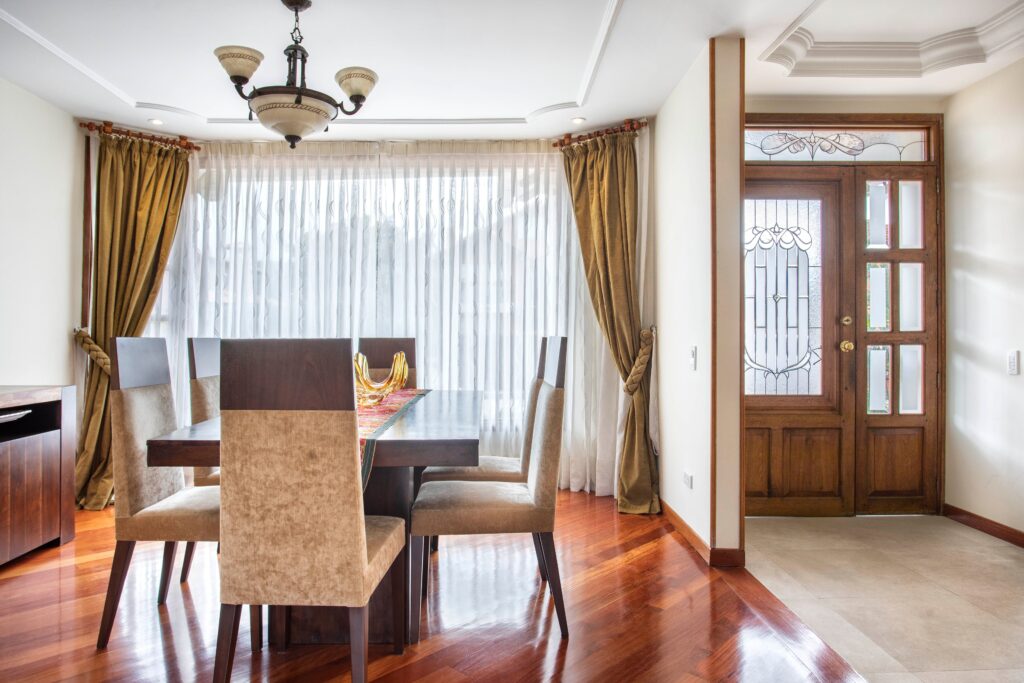
Windows also appear larger when curtains are hung at ceiling height. Because the eye reads the full height of the curtain rather than stopping at the window frame, the perceived size of the opening increases even though nothing about the window itself has changed. This is a useful effect in rooms where natural light is limited or where the windows are smaller than ideal.
Why Curtain Length to the Floor Matters Just as Much
The hang height and the curtain length work together. A curtain that starts at ceiling height but finishes above the floor loses much of the impact of the technique. The floor acts as a visual anchor for the vertical line, and without it, the curtain appears to float rather than ground the room.
In most contemporary interiors, curtains that just skim the floor, finishing within about 10 to 15 millimetres of the floor surface, are the most practical and widely used finish. This length looks neat, reads as intentional, and works well regardless of floor type.
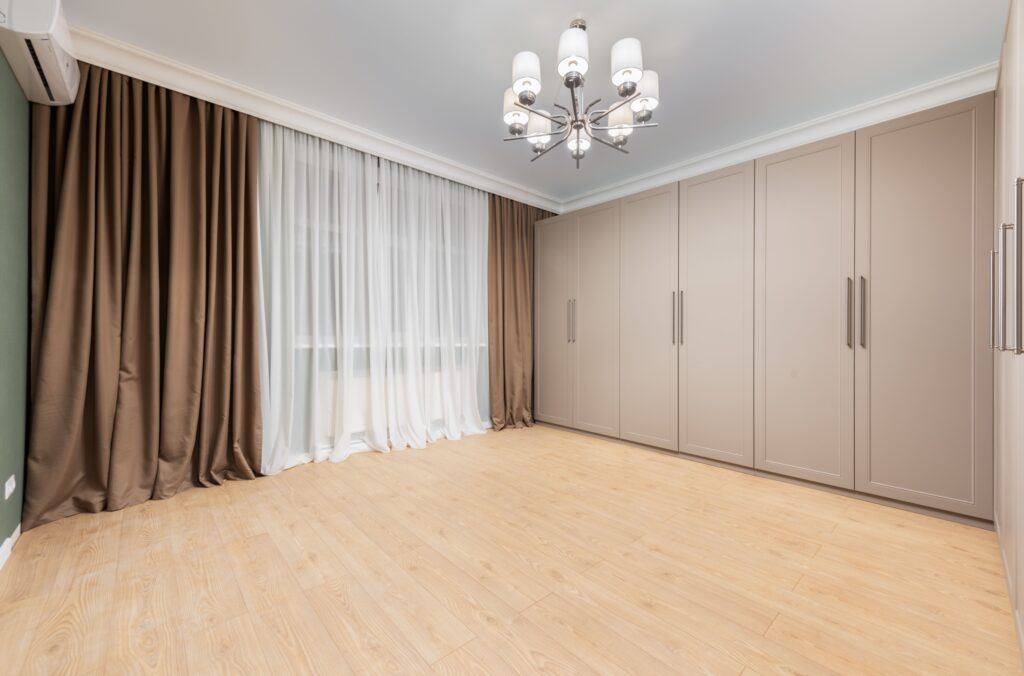
A slight puddle, where the curtain fabric pools gently on the floor by around 30 to 50 millimetres, is a softer finish that suits bedrooms and formal sitting rooms particularly well. It requires a fabric with enough body or weight to pool attractively rather than bunch awkwardly, and it looks best in rooms that are not heavily trafficked. A deep puddle of 150 millimetres or more is a more theatrical choice associated with formal or period interiors, and while it can be beautiful in the right context, it is less practical for everyday family homes.
The Common Mistake: Hanging Too Low
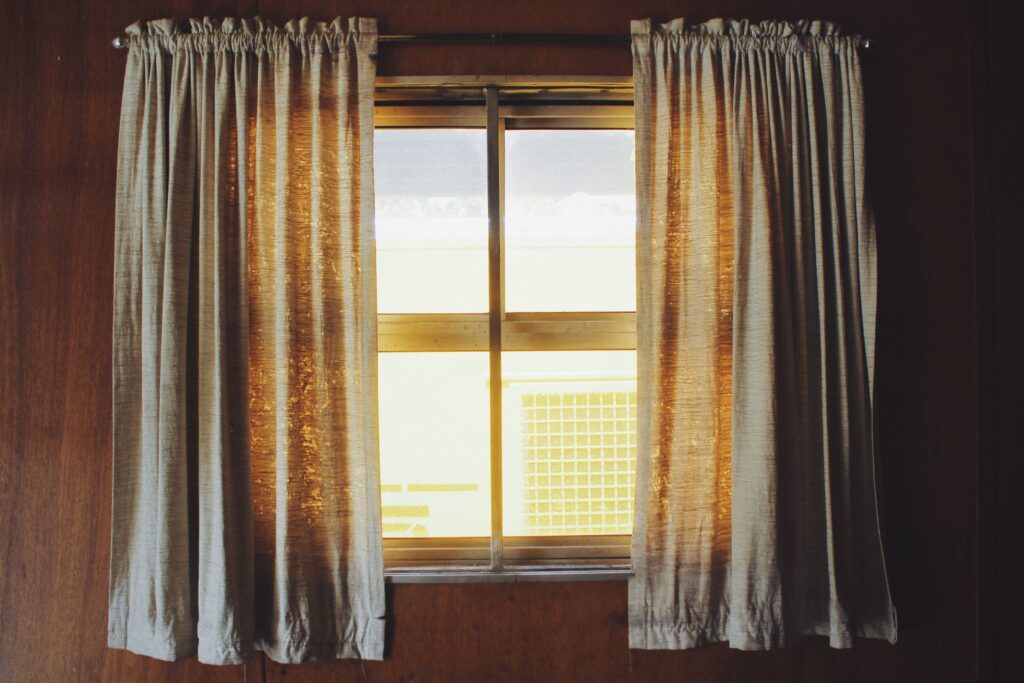
Curtains hung at or just above the window architrave are the single most common curtain mistake in Australian homes, and it is worth understanding why the habit persists. The architrave is a natural visual stopping point, and mounting a rod there is the most intuitive approach if no one has told you otherwise. It also feels safer to mount curtains above the window rather than committing to a ceiling-height installation that requires more planning and a more deliberate decision.
The result, however, is a room that feels shorter, a window that looks smaller, and curtains that look like an afterthought rather than a design feature. Even a modest upward adjustment, moving the rod from directly above the architrave to within 10 to 15 centimetres of the ceiling, makes a visible difference. The closer to the ceiling, the stronger the effect.
In rooms where the ceiling is low and there is little space between the top of the window and the cornice, mounting the rod as close to the ceiling line as the hardware allows is still preferable to defaulting to the architrave. Even a modest gain in hang height, achieved by mounting a slim ceiling track or a low-profile bracket close to the cornice, improves the result considerably.
Ceiling Tracks Versus Wall-Mounted Rods
The hardware choice affects both the practicality and the visual outcome of a ceiling-height installation. Wall-mounted rods positioned close to the ceiling line are a more familiar option and work well in most standard rooms. They allow a range of decorative finial and bracket styles and are generally easier to retrofit in an existing home without specialist installation.
Ceiling-mounted tracks are the choice for a truly seamless, architectural result. Running from wall to wall at ceiling height, these tracks allow the curtain to cover the entire wall when closed rather than sitting only across the width of the window. When the curtain is open, it stacks neatly to the sides, the window is fully clear, and the room retains its sense of openness. Recessed ceiling tracks, which sit flush within the plasterwork, are the most refined option and are particularly well suited to new builds or renovations where the installation can be planned as part of the construction phase.
For motorised systems, ceiling tracks are typically the preferred mounting option because the motor can be concealed within the track profile, keeping the installation clean and unobtrusive. This is a practical advantage in any room, but particularly in bedrooms where visible hardware can feel at odds with a relaxed, restful atmosphere.
Curtain Width and Fullness at Ceiling Height
Hang height and curtain length are only two parts of the equation. The width of the curtain panels matters significantly when the installation runs from ceiling to floor, because any shortage of fabric fullness is more visible at this scale than in a shorter treatment.
As a general guide, each curtain panel should be at least 1.5 times the width of the space it needs to cover when drawn closed. A fullness ratio of twice the width is preferable for heavier fabrics or where a more gathered, luxurious look is the goal. Panels that are too narrow look flat and stretched across the window, which undermines the impression of quality regardless of the fabric chosen.
Stack-back space, the wall area on either side of the window where the curtain sits when fully open, also needs to be factored in. A ceiling-height curtain with generous fullness creates a substantial stack when pulled back, and if there is not enough clear wall space to accommodate it without covering part of the window, the practical benefit of the treatment is reduced. Planning for adequate stack-back at the measurement stage avoids this problem entirely.
Which Rooms Benefit Most
While ceiling-height curtains work in virtually any room, there are spaces where the technique has the most dramatic impact. Living rooms with a single large window or a wall of windows benefit enormously, as the ceiling-height treatment unifies the glazing into a single architectural feature rather than a series of separate openings.
Master bedrooms respond particularly well to ceiling-height treatments, where the combination of full-length fabric and a blockout lining creates the enveloping, hotel-quality atmosphere that makes a bedroom feel like a genuine retreat. Dining rooms are another strong candidate, where the formality and scale of a ceiling-height curtain suits the occasion-focused nature of the space.
Even smaller rooms, including second bedrooms, studies, and sitting rooms, benefit from the technique. The effect of making a room feel taller is arguably more valuable in a compact space than in a large one, where ceiling height is rarely a concern.
Getting the Measurement Right
Accurate measurement is critical for a ceiling-height installation. The drop from the mounting point to the floor needs to be measured at multiple points across the width of the window, because floors and ceilings are rarely perfectly level, particularly in older homes. Even a small variation in floor level across a wide window can result in a finished curtain that appears uneven if the measurement is taken only at one point.
The height of the ceiling itself should be measured rather than assumed, particularly in rooms that have had any renovation work. Cornices, ceiling roses, and air conditioning units near the ceiling can also affect where a track or rod can practically be positioned, and these need to be identified and accounted for before hardware is ordered.
For these reasons, a professional measure is strongly recommended for any ceiling-height installation where accuracy and a clean finished result matter.
Let Peninsula Curtains & Blinds Help You Hang It Right
At Peninsula Curtains & Blinds, we measure, supply, and install ceiling-height curtain treatments across the Mornington Peninsula every day. From selecting the right fabric and hardware combination through to precise measurement and professional fitting, we handle every detail to ensure the finished result looks exactly as it should.
Get in touch to arrange a free measure and quote, and find out how much difference hanging high can make in your home.